
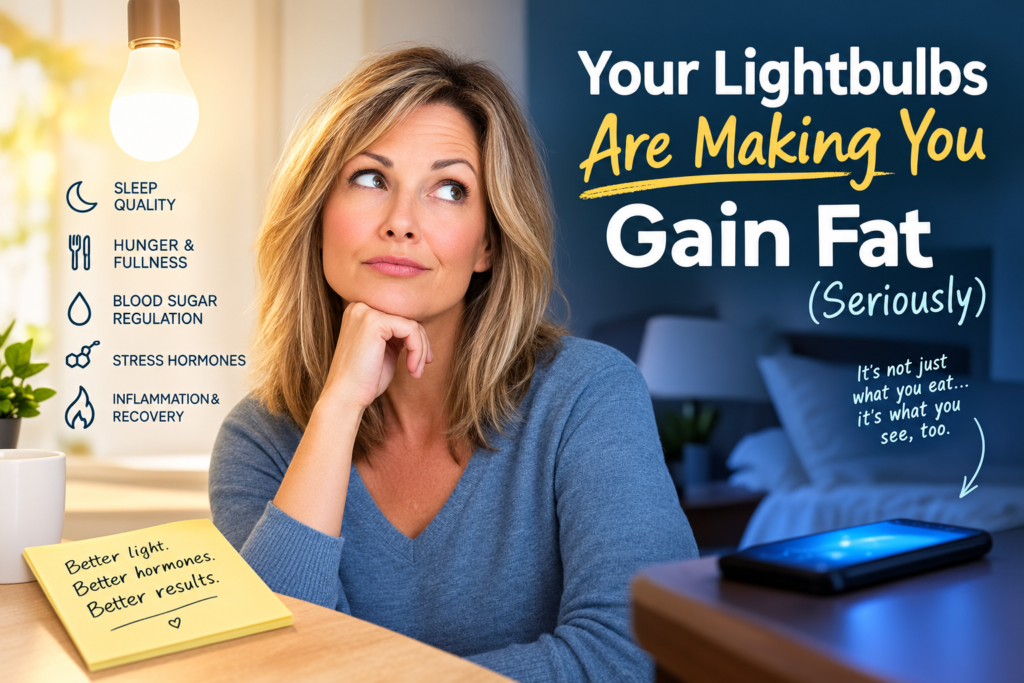
Your Lightbulbs Are Making You Gain Fat (Seriously)
If that headline made you roll your eyes, I get it. It sounds dramatic. But after years of looking at patterns through a root-cause lens, I’ve watched this one small, invisible factor quietly undermine people who are doing so many things right.
You can be eating clean. You can be walking every day. You can be cutting sugar, even doing intermittent fasting. And your weight still won’t budge. Or it’s creeping up around the middle. Or your cravings are strangely loud at night. Or your sleep feels “fine,” but you still wake up tired.
Sometimes the problem isn’t another food rule. Sometimes it’s your light. Not sunlight, the kind your body was built for. I mean the bright indoor lighting and screens that keep your brain acting like it’s noon at 9:30pm.
Let’s break this down in plain language, and look at what you can actually do about it tonight.
Why Light Matters More Than You Think
Your body runs on a built-in clock called your circadian rhythm. Think of it as a 24-hour program that tells your hormones when to rise and when to fall.
This rhythm affects:
- Sleep quality
- Hunger and fullness signals
- Blood sugar regulation
- Stress hormone patterns
- Inflammation and recovery
Your circadian rhythm takes its main cue from light, especially the type and timing of it. Morning sunlight tells your brain it’s day, so it turns on energy and metabolism. Evening darkness tells your brain it’s night, so it turns on repair and deep sleep.
Modern life flips this pattern. Most of us are indoors all day without much bright light, then we get hit with bright overhead lights and screens all evening. Your body ends up confused about what time it actually is, and that confusion has a cost. I call this circadian stress, and it can show up as weight gain.
How Light Affects Your Hormones (and Your Weight)
1. Blue light at night suppresses melatonin
Melatonin isn’t only a sleep hormone. It’s a signal that tells your body to shift into deep sleep, cellular repair, and better glucose regulation overnight.
Blue-toned light from LED bulbs and screens can tell your brain it’s still daytime, which lowers melatonin. When melatonin drops, your sleep quality suffers even if you’re still technically asleep. You may wake more often, feel wired at night, or feel tired in the morning.
If you want better sleep and a steadier metabolism, your body needs dark, quiet signals at night.
2. Poor sleep raises hunger hormones
When sleep is short or shallow, ghrelin (your hunger hormone) tends to rise, and leptin (your fullness hormone) tends to drop. You feel hungrier, crave more, and don’t feel satisfied as easily. This isn’t a willpower problem. It’s biology responding to a lack of rest.
Improving your light habits often quiets those “mysterious” evening cravings.
3. Circadian stress can shift cortisol
Cortisol should be higher in the morning to help you wake up, then gradually fall by evening so you can sleep. But if you’re stressed, sleeping poorly, and exposed to bright light at night, cortisol can stay elevated later than it should.
When cortisol runs high at the wrong time, you might notice belly fat that won’t budge, restless sleep, waking at 2 to 4am, feeling tired but wired, or more blood sugar swings.
Your evening environment should help cortisol fall, not spike.
4. Blood sugar gets harder to regulate
Your body handles glucose differently depending on the time of day and how aligned your circadian rhythm is. When that rhythm is off (late-night light, late meals, inconsistent sleep), insulin sensitivity can drop, cravings can rise, and energy crashes become more common.
This doesn’t mean you need to chase perfection. It means these are the bigger levers worth pulling first.
Signs Your Evening Light Might Be a Problem
You don’t need a fancy device to suspect this. See if any of these sound familiar:
- You scroll at night, then can’t fall asleep for 30 to 60 minutes
- You fall asleep fine but wake at 2 to 4am wide awake
- You crave sugar or snacks most at night
- You feel fine during the day but crash mid-afternoon
- You wake up tired even after 7 to 8 hours of sleep
- Your weight is shifting toward your middle
- Your mood feels more anxious or irritable in the evenings
Light probably isn’t the only factor at play, but it’s often the most overlooked one.
This Is About Patterns, Not Blame
Circadian rhythm touches your hormones, your energy, and your nervous system, which are exactly the systems tied up in stubborn weight, cravings, and fatigue. If those are the symptoms you’re dealing with, light is a logical place to look.
Here’s the encouraging part: this is one of the cheapest, simplest levers you can pull. No supplements required to start.
What To Do Tonight
Here’s a simple plan using the D.R.E.S.S. framework (Diet, Rest, Exercise, Stress reduction, Supplementation) I use with every client.
Diet: Try to finish your last full meal 2 to 3 hours before bed. If you need a snack, choose protein and fiber instead of sugar to keep blood sugar steady.
Rest: Pick a consistent “lights down” time, even just 30 minutes before bed. Make your bedroom as dark as you can manage.
Exercise: A short walk after dinner helps. Keep intense workouts earlier in the day if they leave you wired at night.
Stress reduction: Choose a downshift ritual such as reading, stretching, quiet reflection, or a warm shower. The goal is teaching your nervous system that it’s safe to rest.
Supplementation: Some people benefit from targeted support like magnesium glycinate or melatonin in specific situations, but that’s not where I start. I start with environment and rhythm, and talk with your clinician before adding anything new.
A Simple 3-Step Light Reset
If you do nothing else, try this:
- Get morning light. Step outside for 5 to 10 minutes shortly after waking. This anchors your clock for the whole day.
- Dim the lights 60 minutes before bed. Turn off overhead lights and use a lamp instead. Warmer bulbs help even more.
- Reduce or filter screens at night. Use night mode and keep the brightness low if you’re going to watch or scroll.
That’s it. Not perfect, not complicated, just consistent.
“I Can’t Change My Whole Life”
You don’t have to. Root-cause work isn’t about building a lifestyle you can’t sustain. It’s about changing the inputs that matter most and letting your body respond.
Start with dimmer lights after dinner, warmer light in the evening, and morning sunlight. Give it two weeks and watch what shifts in your cravings, sleep depth, mood, morning energy, and hunger patterns. Weight loss resistance often gets easier to address once these rhythms are supported.
You’re Not Broken
If you’ve been blaming yourself because “nothing works,” hear this: your body isn’t broken. It might just be responding to mixed signals, and light is one of the strongest signals it receives.
If you want help looking at your own patterns through a root-cause lens, grab my free Hidden Inflammation Checklist at myheart4health.net/resources, or book a free call with me directly at myheart4health.net/book.