
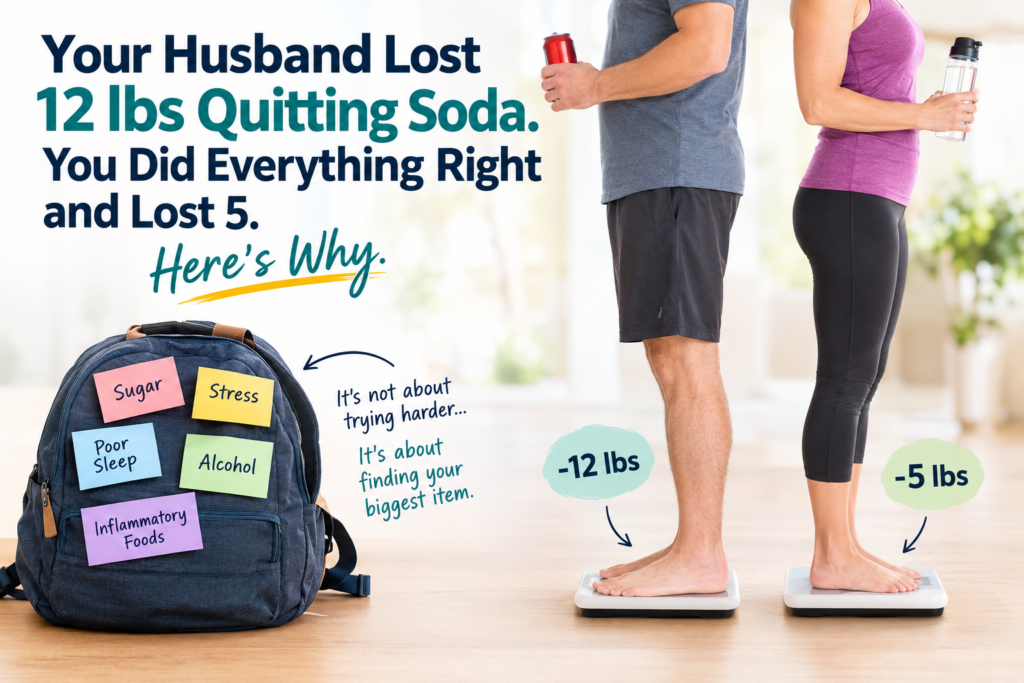
Your Husband Lost 12 Pounds Quitting Soda. You DID Everything Right and Lost 5 Pounds. Here's Why!
Here’s a story I hear all the time. One partner quits soda. Just soda. Nothing else changes. A month later, they’re down 12 pounds.
The other partner has been doing everything right. Cooking at home. Watching portions. Getting to the gym. A month later, they’ve lost 5 pounds. Maybe less.
It feels unfair. It isn’t a fluke, and it isn’t about who tried harder. It comes down to one thing: which piece of the load was actually the heaviest.
Think of It Like a Backpack, Not a Scoreboard
Picture your daily habits as a backpack. Sugar, stress, poor sleep, alcohol, and inflammatory foods all add weight to that pack. Your body carries the total load, not each item one at a time.
Most people try to lighten the pack by taking out a bunch of small, light items. A little less dressing. A smaller portion at dinner. One fewer snack. Those add up eventually, but each one only removes a few ounces.
A daily soda habit is different. It isn’t a light item. Compare it to eating an apple. An apple has natural sugar too, but it also has fiber, so your body has to work to break it down and the sugar enters your bloodstream more slowly. A soda skips all of that. It goes almost straight into your blood.
Liquid sugar hits your bloodstream fast, with nothing to slow it down, no fiber, no fat, no protein. Your body has to release a large burst of insulin to handle it, and it does this every single time you drink one. Do that two or three times a day, and you’re adding one of the heaviest items in the whole pack.
So when someone drops soda completely, they’re not making a small swap. They’re pulling out one of the biggest single items in the bag, all at once. That’s why the number on the scale can move so fast.
You Weren’t Doing It Wrong
If you’ve been eating clean, tracking food, and still barely seeing the scale move, I want you to hear this clearly: you are not failing. You’ve likely been taking out a lot of small items. That work is not wasted. It’s just quieter than pulling one giant item out in one move.
I see this constantly in my coaching practice. One client, I’ll call her Denise, was frustrated because she’d been meal prepping, walking every morning, and cutting her portions, and the scale had barely moved in two months. When we went through her days together, none of her choices were wrong. What we found was she’d been having two glasses of wine most nights to unwind, and that habit alone was heavier than every small swap she’d made combined. Once she cut it back to two nights a week instead of five or more, without changing anything else, the scale started moving again within about two weeks.
The scale doesn’t care how many small, careful changes you made. It responds to the total weight coming out of the pack. If your biggest item is still in there, ten small swaps can’t outweigh it.
Find Your “Soda”
Everyone has one item in their pack that’s heavier than the rest. It’s rarely as obvious as a soda can on the counter. Here are the most common hiding spots:
- A nightly glass (or two) of wine. Alcohol is processed by your liver before anything else, which delays fat burning while it does.
- Grazing all day, even on healthy food. Constant small bites keep insulin elevated most of the day, even if the food itself is “clean.”
- “Healthy” foods with hidden sugar. Flavored yogurt, granola, protein bars, and salad dressings often carry more sugar than people expect.
- Mindless snacking on cookies, chips, or other packaged food. It’s rarely “just one.” A sleeve or a bag disappears without much notice, and it adds up fast.
- Weekend “treat days” that quietly undo five days of effort. One or two bigger days, extra drinks, dessert, takeout, can outweigh a whole week of small, careful choices.
- Eating a large meal late at night. A big dinner close to bedtime keeps insulin working while your body should be winding down and repairing.
- Poor sleep. Short or broken sleep raises the stress hormone cortisol, which tells your body to hold onto fat, especially around the middle.
None of these looks like a “bad habit” the way a soda can does. That’s exactly why they get missed.
What This Looks Like in a Real Day
You don’t need to overhaul everything at once. Here’s a simple version of lowering the load in practice:
- Morning: Start with protein instead of something sugary, eggs, Greek yogurt, or a protein shake instead of cereal or a pastry.
- After lunch: Take a 10-minute walk. Even around the block counts.
- Afternoon: When the 2 p.m. craving hits, remember it’s biology, not a lack of discipline. Reach for protein or fiber first.
- Evening: Start winding down 30 to 60 minutes before bed. Dim the lights, put the phone away, keep the room cool.
None of this is extreme. It’s just consistent. And once you’ve found your biggest item and removed it, this kind of steady rhythm is what keeps the progress going.
A 3-Question Audit to Find Your Biggest Item
Grab a notebook or just think through these:
- What do you do every single day, without fail, that involves sugar, alcohol, or late-night eating? Daily habits carry more weight than occasional ones.
- What’s the thing you catch yourself explaining away? “It’s just one glass.” “It’s basically healthy.” If you’re defending it, it’s worth a second look.
- If you could only remove one thing this week, and nothing else, what would move the needle most? That answer is usually your biggest item.
Once you find it, start there. Not with ten new rules. With one.
This Doesn’t Mean Stop Doing Everything Else
The small changes still matter. Cooking at home, moving your body, watching portions, all of it adds up over time and it’s part of a healthy pattern for life, not just for the scale. But if the scale feels stuck no matter how many small things you fix, stop adding new rules for a minute. Go find the biggest item in the pack first.
That’s usually where the fast, visible progress is hiding. Not in trying harder at everything. In removing the one thing that was heaviest all along.
You’re Not Behind. You Were Solving the Wrong Problem.
If this is you right now, doing everything “right” and still not seeing the number move the way you hoped, it doesn’t mean you need more willpower or a stricter plan. It usually means the biggest item is still sitting in the bag, and no amount of small swaps around it will make up the difference.
Find it. Remove it. Then let your body catch up.
Here’s one more piece worth knowing: sugar doesn’t just add empty calories, it also feeds inflammation in your body. And inflammation doesn’t just make weight loss harder, it can affect your joints, your energy, even your skin.
If hidden sugar and food sensitivities are part of what’s weighing you down and you’re not sure where to start looking, I put together a free Hidden Inflammation Checklist to help you spot it.
And if you’d rather have a second set of eyes on your specific situation, I offer one-on-one coaching. You can book a free call with me at MyHeart4Health.net.